
India and Pakistan have been arch rivals since the time of their independence, and Pakistan can always be seen chasing India, although India being a big, responsible and sensible country is ahead in every aspect.
Since independence, India and Pakistan have been involved in mutual conflicts at various times in history. We all know that there was a time when both countries were competing to become nuclear power countries. After the Indo-Pakistan war of 1971, the Indian Army had long been advocating for practicing modern methods of land-based warfare and professionalism.
Considering this in mind, India strategically launched Operation Brassstacks. There are theories of several possible purposes of this operation, so it is important to first talk about the scale of this operation.
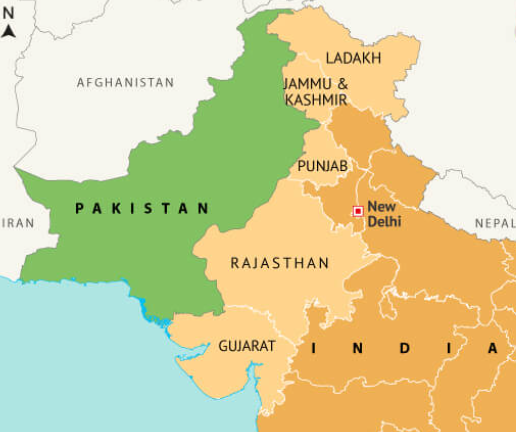
Operation brasstacks was held in the Western Border of India from November 1986 to March 1987. It is said to had the largest number of troops assembled in a region since World War II. It is said that at the time of the operation, half of India’s military capability, which is about 4–6 lakhs, was gathered in the Thar Desert region of Rajasthan, less than 100 miles from Pakistan. At that time, NATO’s military exercise had been called the world’s largest military gathering, but after this operation, India had shown the world that a single nation can also exercise on such a large scale. Operation Brassstacks was a wargame exercise conducted by the Indian Armed Forces, to prepare and test for deep strike offensive capabilities. India showed its computers and electronic warfare capability to the world for the first time in this military exercise. Experts also said that India has joined the club of few large countries of the time to have the capability of electronic tank warfare. It is said that Nine infantry divisions, three mechanised divisions, three armoured divisions, one air assault divisions, and three armoured brigades of the Indian army were part of this exercise. This was the period when the eyes of the whole world were on India and India was carrying out its mission regardless of the world and without any pressure.

The then Chief of Staff of the Indian Army was General K. Sundarji, about whom it is said that this operation was his own brainchild. He had expertise in planning large scale battles and according to him, the core objective of Operation Brasstacks was to test new concepts of mechanization, mobility, and air support devised by the Indian Army. Apart from this there were two other objectives of the exercise, first was, to get the soldiers battle ready by deploying them on a large area of battlefield to check and practice their capability to react in a war like situations, and second was, to check whether Indian Army and Indian Navy can attack together, for which they conducted a series of amphibious assault exercises near Pakistani Naval Base, though no single shots were fired. Experts say that another specific objective of this operation was to find out the nuclear strategy of Pakistan and act accordingly, because until this time Pakistan never accepted publicly that they were trying to make a nuclear weapon, however Indian and other countries intelligence had inputs that they were trying this for the last 10 to 12 years.
The scale of this military exercise was so huge that at one point Pakistan leadership and strategists began to feel that they were about to be attacked and they regarded this war game as a threatening exhibition of India’s military power. To answer this, Pakistan also deployed its army on the borders, but keeping in mind the insurgencies inside the Indian state of Punjab, adopting a new maneuver, kept the number of soldiers more on the Punjab border resulting in counter deployment by India. By mid of january 1987, both the armies stood within the firing range along the extended border area. Pakistan also put high alert on all its nuclear installations.

The Indian subcontinent was on the verge of a war. But here onwards diplomacy came into action and then common love towards the game of cricket, played its part in ease of the tension. Eventually in Feb 1987, Zia Ul Haq was invited to watch a game of cricket in Jaipur and after this he met Indian Prime Minister Rajiv Gandhi in New Delhi. In this meeting both leaders agreed to withdraw their army from the border in a phased manner to ease the tension and avoid war. They also signed some other confidence building measures to avoid any future escalation.
In this way the tension diminished by the end of March of 1987. On December 31, 1988, a Non Nuclear Aggression Agreement was signed by Rajiv Gandhi on his visit to Pakistan. This ensures the prohibition of attack against each other’s nuclear installations and facilities.
Also, at the height of the build up, India Army leadership decided to provide full scale briefing to the Indian and international media about the Brasstacks exercises, in which General Sundarji declared that they were non-provocative.

The New York Times published an article, “On India’s border, a huge mock war”, in which they mentioned Pakistani nuclear program’s director, Dr. A. Q. Khan, who was quoted by an Indian journalist as confirming that Pakistan had indeed produced a bomb. Dr. Khan has since said his comments were taken out of context. New York Times also quoted an western diplomat who says, ‘’This is not a third-world army, this is a modern army, fully competent for any mission, easily as good as the Chinese, the Koreans or the French.’’
However, General PN Hoon, then commander-in-chief of the western command maintained that General Sundarji did not inform Prime Minister Rajiv Gandhi about the scale of the operation and such details were hidden from him. Hoon also wrote in his memoir: “Brasstacks was no military exercise. It was a plan to build up the situation for a fourth war with Pakistan.”
It is theorised by author Robert Art and others that the General Sundarji’s strategy was to provoke Pakistan to respond and this would provide India with an excuse to implement existing contingency plans to go on to the offensive against Pakistan and take out its atomic bomb projects in a series of preventive strikes.
There may be a large number of theories and speculations about the objectives of this operation but India strengthened its position in the international arena as a country and as a military power.
Comments
Post a Comment